Primary Control Part III - Roll Up
Jul 05, 2026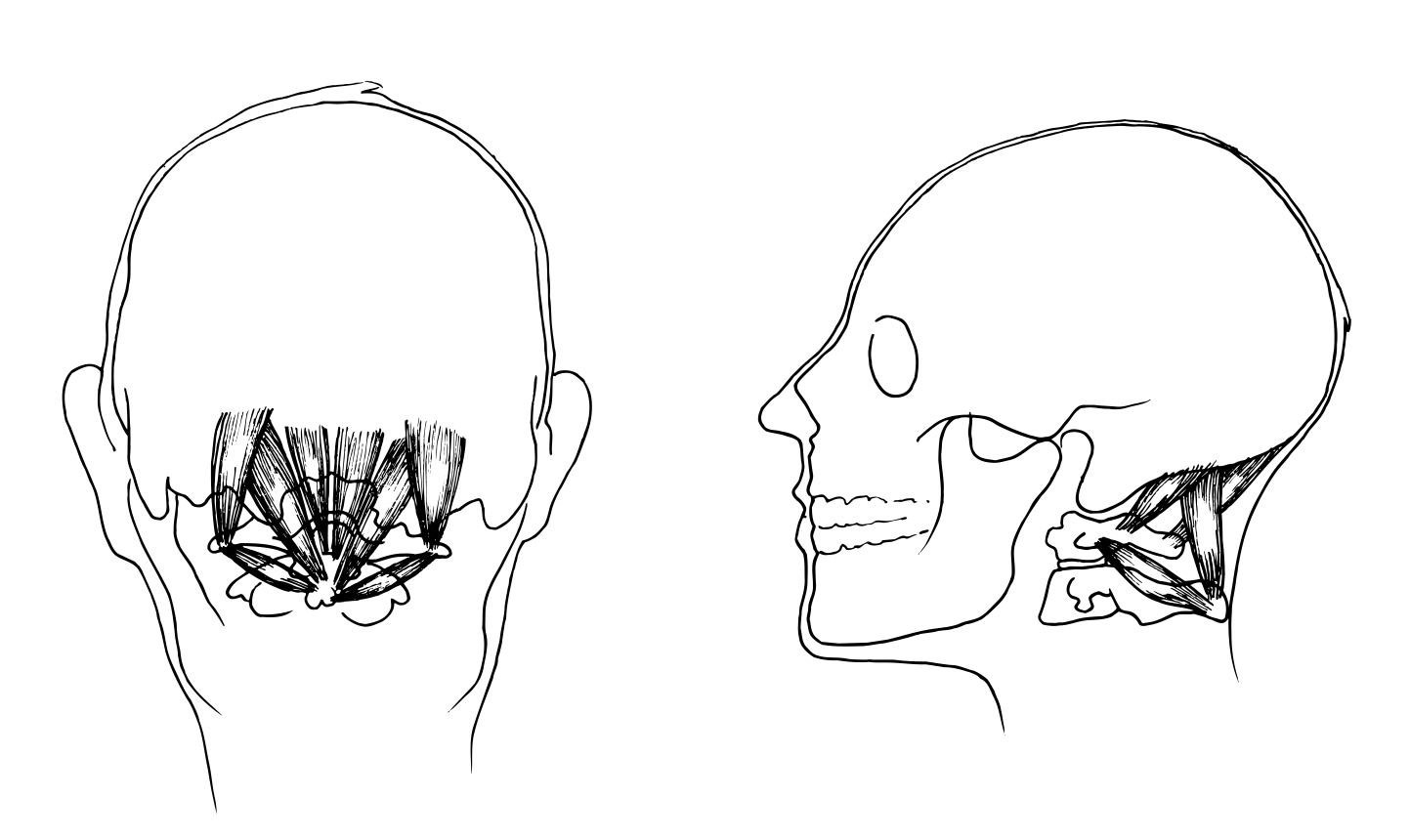
These days, I am getting a reputation among zen place clients who struggle with Roll Up.
I wrote previously about Junko who had waited 18 years before she could finally do a Roll Up at my PILANDES Trial. Next Trial, two more candidates appeared…
“I have only done it once in 10 years” and “I have never been able to do it.”
Oh boy, I thought, now I have to deliver.
And deliver we did – because the key to an effective Roll Up is Alexander’s Primary Control. Educators and clients please take note:
Roll Up starts with a head movement, not a massive contraction!
The way your head connects to your spine involves an extraordinary group of muscles going under the general name of the “sub-occipital muscles” (shown above). These are short, bone-deep muscles running from various origins on the first two vertebrae (Atlas & Axis) up to the base of the occiput bone of your skull.
I have spent years exploring these sub-occipital muscles – they are an unknown, hidden sensory device of great power that very few appreciate as crucial to movement guidance.
Had you heard of them?
In fact, in this area below the skull, there are more sub-occipital muscles than are officially counted, but that’s for the experts to sort out. All we need to know now is that 1. they are there; 2. they are sensory rather than motor and; 3. they inform the entire system through partially documented pathways to multiple areas in your brain.
They are significant in ways that other muscles are not.
Alexander’s discovery that his head movements governed his vertebral coordination – i.e. head orientation is a primary organiser of movement – obviously confers these muscles more significance than a fitness educator might give them. On further examination, we discover another fascinating fact:
Sub-occipitals are, by the most rigorous modern measure, among the most spindle-rich muscles in the entire human body. Muscle spindles are tiny sensors embedded inside your muscles that continuously report back to your brain on the muscle’s length and how quickly it’s changing. Think of them as your body’s internal GPS for movement — without them, you’d have no sense of where your limbs are or what your posture is doing.
Can you see now how important it is for Roll Up to start with a tiny forward head tilt?
When you begin Roll Up by first tilting your head forward, PILANDES proposes that you are now signalling this direction to those sensitive sub-occipital muscles – this in turn directs your Postural Movement System (PMS) to recruit the extensive muscular support required to automate your sit-up. *
Instead, what has been happening in those who fail at Roll Up, is a Voluntary Movement System (VMS) inspired “effort” causing massive contraction in the neck muscles (and often simultaneously in the abdominal muscles!). Unfortunately, many of these neck muscles are normally used for extension, not flexion. Therefore, you are signalling the wrong direction to your brain.
Having signalled extension, you then try to go into flexion and basically – you’re at war with yourself. No wonder you stop halfway. Every time. For 10 years. For 18 years – until the day, finally, you….
Well, come along to my PILANDES workshop in London or New York to experience by my hands how Alexander’s Primary Control can optimise your Roll Up.
It’s in the cueing, not the doing.
NEXT: Are you Feeling Older?
Stay tuned.
* Of course, this all lives in the domain of Alexander’s discoveries, and neuroscience today can offer us only a partial glimpse of this mechanism at work. There is nothing that disputes it, but still very little to confirm it, including even confirmation of the cortical areas of the brain that are directly informed by sensory information from the sub-occipital muscles. We still don’t definitively know.
2026 Workshops
LONDON:
August 8 – PILANDES
August 23 – Trauma-Informed AT
NEW YORK:
October 24 – PILANDES
October 25 – Trauma-Informed AT
Join Jeremy's (sometimes) Daily
Hear what Jeremy's writing about now — Alexander Technique, PILANDES, Trauma-Informed Alexander, and more.