Somatic Therapy with AT – Using Touch
Aug 15, 2026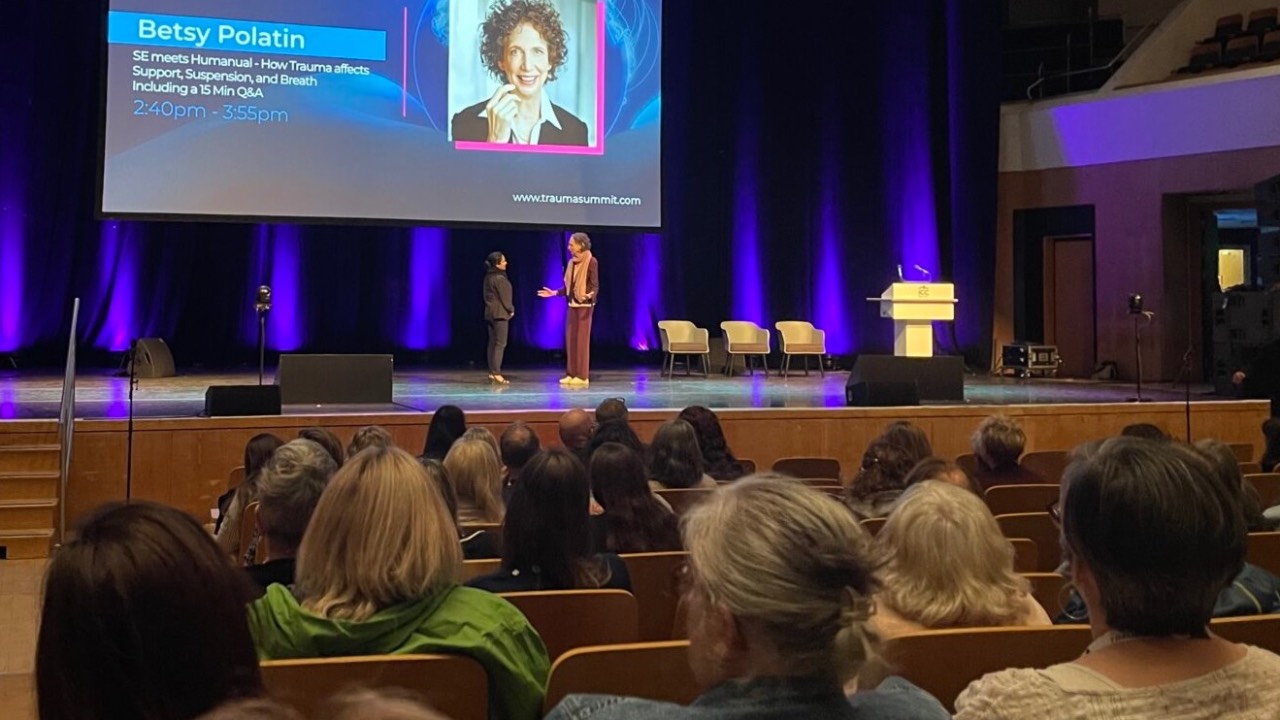
Betsy Polatin, while leading her HUMANUAL Trauma Resolution training for 14 Professional ATeachers in Malibu this year, told us the story of how whenever Gabor* needed a participant calmed down, he called in Betsy - because Betsy always can.
And we know one reason why, even if other people don’t.
Our Alexander touch - it’s a miraculous force.
Nature harnessed into a glacial tsunami…
***
Elisabeth Walker once described to me her first lesson with F.M. Alexander.
Of all the teachers FM trained, Elisabeth was the last to pass away at 98, in 2013. She told me that after her first lesson with FM, all she remembered thinking as she walked away from Ashley Place was:
“How am I ever going to get this back?”
Her state was transformed by FM Alexander’s touch. No doubt Alexander used his hands with Elisabeth from start to finish. Even today in London, a classic 30-minute individual AT lesson will often involve a teacher using their hands with you most of the time. You are touched many, many times.
This continuous touching is referred to as “Alexander Hands-On”. Teachers spend decades perfecting the way they use this touch. And this touch - as it turns out - is the skill set that ushers Alexander teachers confidently into a field that is already on fire.
USING TOUCH
Previously, I introduced Tommy Thompson’s magical exercise of telling a story from your past twice: 1st time alone, then 2nd time as Tommy uses Alexander “hands-on” with you. Tommy’s exercise totally depends upon touch to succeed - touch is the whole point. Below I describe how that works, defining three uses for TIA Touch.
1. TIA RESOURCE TOUCH
A person’s interoceptive and proprioceptive environments can be delicately altered by TIA Touch. The touch prompts you to associate with your present-time field of attention, thereby switching you away from your obsessive association with trauma.
This is the closest to the classic Alexander “Hands-On”: bringing you back into a balanced condition. This is how a Resource functions more generally in Somatic therapy. I suspect this is how Tommy was touching, in his original version of the exercise.
2. TIA TITRATION TOUCH
You don’t want your clients to tip back into being traumatised again - this is a constant restraint in Somatic therapy. There are multiple ways to achieve this, and Alexander Touch is an elegant choice: you titrate the emotional roller coaster by simply placing your hands appropriately to modulate your client’s pendulation.
3. TIA PENDULATION TOUCH
Pendulation here refers to how your touch is able to either amplify or diminish the physical expression of trauma.
There is a binary rhythm in all of us - moving back and forth along a sliding scale. Breathing is the most obvious example, along with your heart beating. Your whole nervous system operates this way, including the somatic recollection of trauma and its consequent discharge. This is the innovative use of TIA Touch - to delicately modulate the client’s movements as they are experiencing their trauma.
TIA TOUCH DIFFERENCES
Classic “hands-on” Alexander touch is solely focused on energising the underlying Postural Movement System’s (PMS) unidirectional movements - this causes many of the stereotypical Voluntary Movement System’s (VMS) patterns to simply evaporate, leaving freedom and lightness in its wake. That is why it is most suited to acting as a Resource in TIA work. In most Alexander circles, this is called “giving your directions.” ※
How about going the other way?
Teachers understand this can be done; they just don’t do it that often. Usually they have no reason to amplify a person’s VMS-generated stereotypical movements. One reason is to assist clients in identifying unconscious patterns that are causing them grief; but many teachers do not do this, and even if they do - not often.
However, in TIA work, it is central.
By encouraging you to move with your somatically-based trauma, TIA Touch can modulate the nervous system’s pendulation. Provided it is safe, following along with a trauma’s movement may amplify emotional associations with other episodes in your life…
This is how you navigate time within the complex architecture of your personality.
But how do you navigate an entire session?
In Somatic therapies, they often refer to Orientation and Tracking as essential skill sets that help shape the overall arc of a session. However, Trauma-Informed Alexander takes a sharp turn in another direction, and to discover more about that - make sure you read my next (sometimes) Daily.
NEXT: Somatic Therapy with AT - Unified Field
Stay Tuned.
* Betsy Polatin MFA, SEP, AmSAT has been co-teaching with Dr Gabor Maté – “The Wisdom of Trauma” for about 7 years. Gabor’s depth of knowledge of trauma blends well with Betsy’s HUMANUAL teachings. His extraordinary ability to dive into trauma balances well with her skilful observations of precise physicality. They both share a sense of humour! Betsy will be teaching with Gabor at the Oxford Trauma Conference this coming September.
※ These days there are teachers who do not advocate the “giving of directions” in the classic way Alexander described it in CCCI, Part II, Chapter IV, “Illustration”. At first glance, this approach appears to be a movement focused more on readiness and presence of mind - believing that from this awakened condition, coordination can naturally flow.
NOTE
This is the 5th in a series of 12 emails as a prelude to my Trauma-Informed Alexander workshop in London (August 23rd) and New York (October 25th). You can book at the link below. Email me for a discount if you are an AT trainee or financially challenged:
Join Jeremy's (sometimes) Daily
Hear what Jeremy's writing about now — Alexander Technique, PILANDES, Trauma-Informed Alexander, and more.