Pain is What is Right About You
May 22, 2026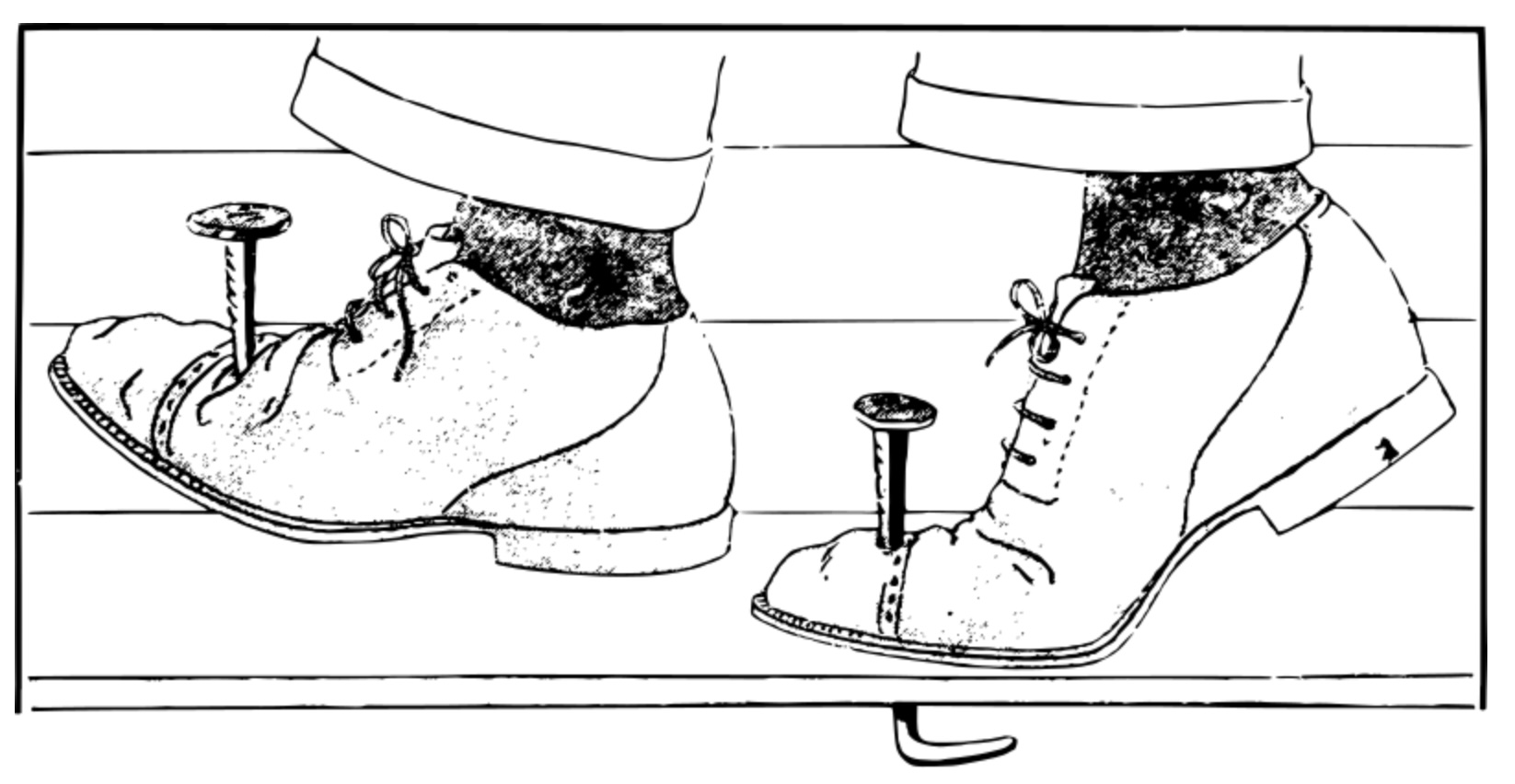
"You say it is wrong for the boy to be frightened. I say you are wrong in saying so. I should say it would be serious if he were not frightened when he is in the condition he is." — FM Alexander, Teaching Aphorism No. 37
In the world of pain academia, there is a famous report from BMJ, 1995* about a 29-year-old construction worker. He had jumped down onto an upright 15cm nail, which penetrated right through his boot. When he arrived at the hospital, he was in such agony that they had to administer fentanyl and midazolam before they could pull the nail out from below, remove the boot and examine the damage to his foot…
They were amazed by what they found.
The nail had passed between his toes! There was no damage to his foot. And yet, everyone felt sure that this man had been feeling genuine pain. The slightly contested conclusion was simple:
Pain is produced by the brain when its map predicts a threat to the body.
As we have seen throughout my PILANDES series, myths arise because our brain predicts from maps — not from direct perception — which can result in incorrect predictions. Like the frog with the rotated eye, remember? The insect was not where he predicted it to be.
The idea that pain always reflects tissue damage is another outdated myth.
Then what is pain?
In particular — more accurately for us — what is postural pain?
Your brain utilises postural pain to warn you when you are misusing your postural design. Think of it this way: if you wore your left shoe on your right foot all day, how do you think your foot would feel? Pretty sore, I'm guessing. Your foot is letting you know that the shoe is not cooperating with its design. And the foot is not wrong, is it? Postural pain works in a similar way.
This is the specific myth I am disassembling today:
Postural pain is not what is wrong about you — postural pain is what is right about you.
When you do something against your postural design, postural pain is how your brain lets you know. When you don't listen, when you push through and try to keep going regardless, your system starts to falter, which produces something much worse — something you want to avoid at all costs. I will cover that next in my Science leaning Daily.
From its first onset, postural pain is trying to tell you something: listen to me.
In PILANDES we listen: when something hurts, we stop. We investigate, we take time.
We listen to postural pain by trying to analyse what is going on. Of course, PILANDES benefits from Alexander's discoveries of how your underlying postural movement optimises the way you do things…
***
A small example was the woman with the clicking hip. She came to a PILANDES Trial and wanted to know why her hip kept clicking on one side and not the other.
"I have no idea," I answered her, "Let's investigate."
Upon watching her do Knee Hold on both sides — i.e. from lying in semi-supine, bending each knee all the way up over her chest in turn — I noticed that she lifted one leg differently from the other. On one side, she didn't bend the knee at all, but instead instantly used the muscles around the hip to do all the lifting of the leg.
"Is this the one that is clicking?" I asked her.
"It is clicking now, can't you hear it?"
I couldn't, but I could guess why it might be clicking.
I had her bend at her knee first — just a little — then bend at her hip. This relieved her hip flexors from having to pull up the full weight of her leg, distributing the work to the muscle groups that bent her knee. After repeating that two or three times, she reported:
"It isn't clicking!"
***
I always feel great gratitude towards Alexander's discoveries at moments like this. FM's simple discovery of how postural movements optimise voluntary movements has endless applications. PILANDES applies this discovery very specifically to the voluntary movements of Pilates. In these cases, the role of postural pain or discomfort is to get you to stop, think and analyse why.
When you feel postural pain or discomfort, remember that it is there to guide you.
NEXT: The Pain that Won’t Go Away
Stay tuned.
* Fisher JP, Hassan DT, O'Connor N. Minerva. BMJ. 1995;310:70. This is a brief clinical report published in the "Minerva" column of the British Medical Journal — a miscellany section featuring short case observations. The item has no formal article title.
2026 Workshops
LONDON:
August 8 – PILANDES
August 23 – Trauma-Informed AT
NEW YORK:
October 24 – PILANDES
October 25 – Trauma-Informed AT
Join Jeremy's (sometimes) Daily
Hear what Jeremy's writing about now — Alexander Technique, PILANDES, Trauma-Informed Alexander, and more.